A little perspective
The universe puts things in perspective. Put two worlds beside each other. Discover how big they really are—and how small the familiar can become.
Start withCeres Pluto Moon Mercury Ganymede Mars Venus Earth Neptune Uranus Saturn Jupiter Sun Betelgeuse ⇄ Compare withCeres Pluto Moon Mercury Ganymede Mars Venus Earth Neptune Uranus Saturn Jupiter Sun Betelgeuse Compare with Earth
One scale. Two worlds. True diameter scale
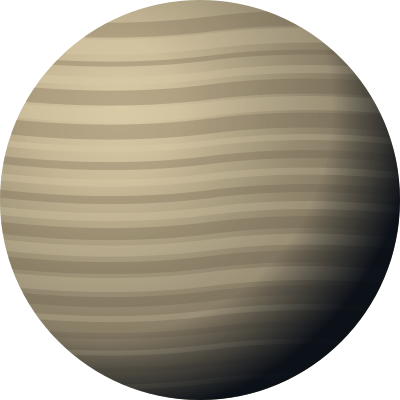
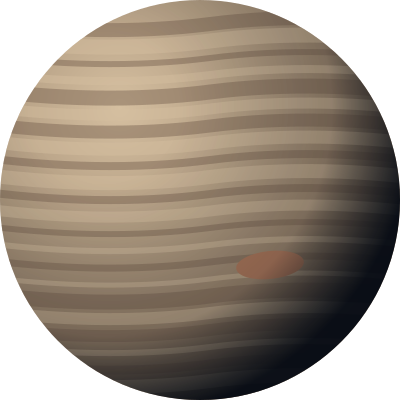
Earth and Jupiter to scale Their diameters differ by a factor of 10.973. Illustrations show body diameter, not separation in space.
Body diameters to scale. Positions and surface artwork are illustrative; Saturn’s rings are excluded.
Side by side How many across?
Copy this comparison ↗ A change of perspective
10.973× the diameter. See how the two worlds measure up.
Diameter is a distance across an object. Volume grows with the cube of that distance.
Earth: Twice the source mean radius; body diameter only, excluding rings.
Jupiter: Twice the source mean radius; body diameter only, excluding rings.
How we measure size → This initial comparison is shown to scale. Enable JavaScript to change objects, explore the journey, and calculate a miniature model. You can still read every object guide below.
Start with something familiar. Then look beyond it.
Choose two objects, compare their true diameters, or shrink them to a scale you can hold in your hand. There is no finish line. Just another way to see our place in things.
Prefer a little guidance? Take five steps through the scale of space .
From a small world to a giant star
Meet the objects 14 perspectives Directory illustrations are not to scale. Open an object to compare its actual diameter.